Nigehban Dastarkhwan 2026 – Maryam Ke Mehman Free Rashan Initiative
Complete Guide to Eligibility, Registration Process, Rashan Package Details, and Transparent Distribution in Punjab
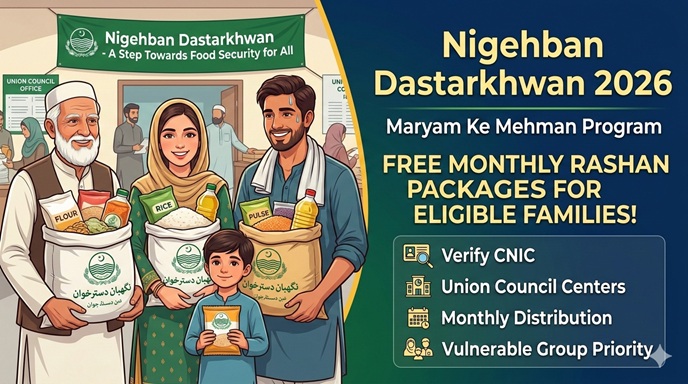
Nigehban Dastarkhwan 2026, also known as the Maryam Ke Mehman program, is a large-scale relief initiative introduced under the leadership of Maryam Nawaz. The program aims to provide free monthly rashan packages to financially struggling families across Punjab.
With food prices rising steadily, many households are finding it difficult to manage daily kitchen expenses. This initiative offers structured and transparent support to ensure deserving families receive essential grocery items without financial burden.
What Is Nigehban Dastarkhwan 2026?
Nigehban Dastarkhwan 2026 is a province-wide social welfare program operating under the supervision of the Government of Punjab.
Its mission is clear:
No family in Punjab should go to bed hungry.
The scheme primarily supports:
Low-income households
Daily wage earners
Widows and orphans
Unemployed individuals
Families living below the poverty line
By targeting vulnerable communities, the initiative strengthens Punjab’s social protection system and reduces the impact of inflation on essential food consumption.
Key Objectives of the Maryam Ke Mehman Program 2026
The program is built around four major goals:
1. Monthly Free Rashan Distribution
Eligible families receive essential grocery items every month at no cost.
2. Priority for Vulnerable Groups
Households already listed in official welfare databases are given preference.
3. Transparent & Verified System
CNIC-based digital verification minimizes fraud and duplicate claims.
4. Reduction of Food Insecurity
Both urban and rural communities benefit through structured distribution channels.
This organized framework enhances accountability and ensures fair allocation of resources.
What Items Are Included in the Rashan Package?
The monthly rashan package consists of daily-use grocery essentials necessary for an average household.
Monthly Package Contents
| Item | Household Purpose |
|---|---|
| Flour (Atta) | Basic roti preparation |
| Rice | Regular meal option |
| Pulses (Daal) | Protein source |
| Cooking Oil | Meal preparation |
| Sugar | Tea and cooking |
| Tea | Daily consumption |
These carefully selected items help maintain basic nutritional requirements.
Distribution is generally arranged at Union Council offices or officially designated centers to maintain smooth operations.
Eligibility Criteria for Nigehban Dastarkhwan 2026
To qualify for the program, applicants must:
Be a resident of Punjab
Hold a valid Computerized National Identity Card (CNIC)
Belong to a low-income household
Not be receiving duplicate food subsidies from other government programs
Families already recorded in official social welfare databases may receive priority consideration.
Registration Process – Step-by-Step Guide
The application procedure is simple and citizen-friendly.
Step 1: Visit the Nearest Registration Center
Go to your local Union Council office or authorized registration point.
Step 2: Bring Your Original CNIC
Identity verification is mandatory.
Step 3: Submit Household Information
Provide basic details regarding income and family size.
Step 4: Digital Verification
Authorities verify your data through official databases.
Step 5: Receive SMS Confirmation
Eligible applicants receive an SMS containing collection details and distribution schedule.
Selected families are informed about the exact pickup date and location via mobile notification.
Transparency & Digital Monitoring in 2026
The 2026 phase introduces stronger monitoring systems to enhance accountability.
Transparency Measures Include:
CNIC-based verification
Digital cross-checking of records
SMS status alerts
Complaint helpline services
On-ground monitoring teams
These mechanisms reduce misuse and ensure that only deserving families benefit from the program.
Applicants experiencing delays can contact official helplines or revisit their registration center.
Impact During Inflation
With rising inflation affecting food prices across Pakistan, low-income families are under significant financial pressure. This initiative directly supports:
Household food stability
Daily wage earners with irregular income
Widows managing families independently
Rural communities with limited earning sources
By covering essential grocery needs, the program helps reduce economic stress and improve living standards.
How Nigehban Dastarkhhwan Differs from Other Rashan Schemes
Many people confuse this initiative with local charity drives. However, there are clear differences:
| Feature | Nigehban Dastarkhwan 2026 | Local Rashan Drives |
|---|---|---|
| Managed By | Government of Punjab | NGOs / Private donors |
| Registration | CNIC-based system | Manual lists |
| Tracking | SMS alerts | Limited follow-up |
| Coverage | Province-wide | Area-specific |
| Monitoring | Digital verification | Basic supervision |
The structured digital model ensures fairness and transparency at every stage.
Common Issues Faced by Applicants
Some applicants may experience:
Delay in SMS notifications
CNIC mismatch errors
Incomplete registration details
Duplicate subsidy alerts
In most cases, updating information at the Union Council resolves the problem.
Always ensure your CNIC details are accurate and updated before applying.
Frequently Asked Questions (FAQs)
1. How can I check eligibility?
Visit your nearest Union Council office and verify your CNIC through official registration channels.
2. Is online registration available?
Registration is primarily conducted at designated centers. Digital verification is handled internally.
3. How often is rashan distributed?
Eligible families typically receive support on a monthly basis.
4. Can government employees apply?
Eligibility depends on income criteria and official database verification.
5. What if I don’t receive an SMS?
Revisit your registration center to confirm your application status.
Conclusion
Nigehban Dastarkhwan 2026 – Maryam Ke Mehman Free Rashan Initiative represents a significant step toward poverty alleviation in Punjab. Through structured registration, digital verification, and transparent monitoring, the program ensures that essential food supplies reach deserving families fairly and efficiently.
This initiative not only addresses immediate food needs but also strengthens the province’s long-term social welfare system.