PPSC Syllabus Analysis 2026: Master Your Exam Marks
Comprehensive PPSC Syllabus Analysis 2026: Breakdown of Subject Weightage, High-Yield Topics, and Preparation Hacks

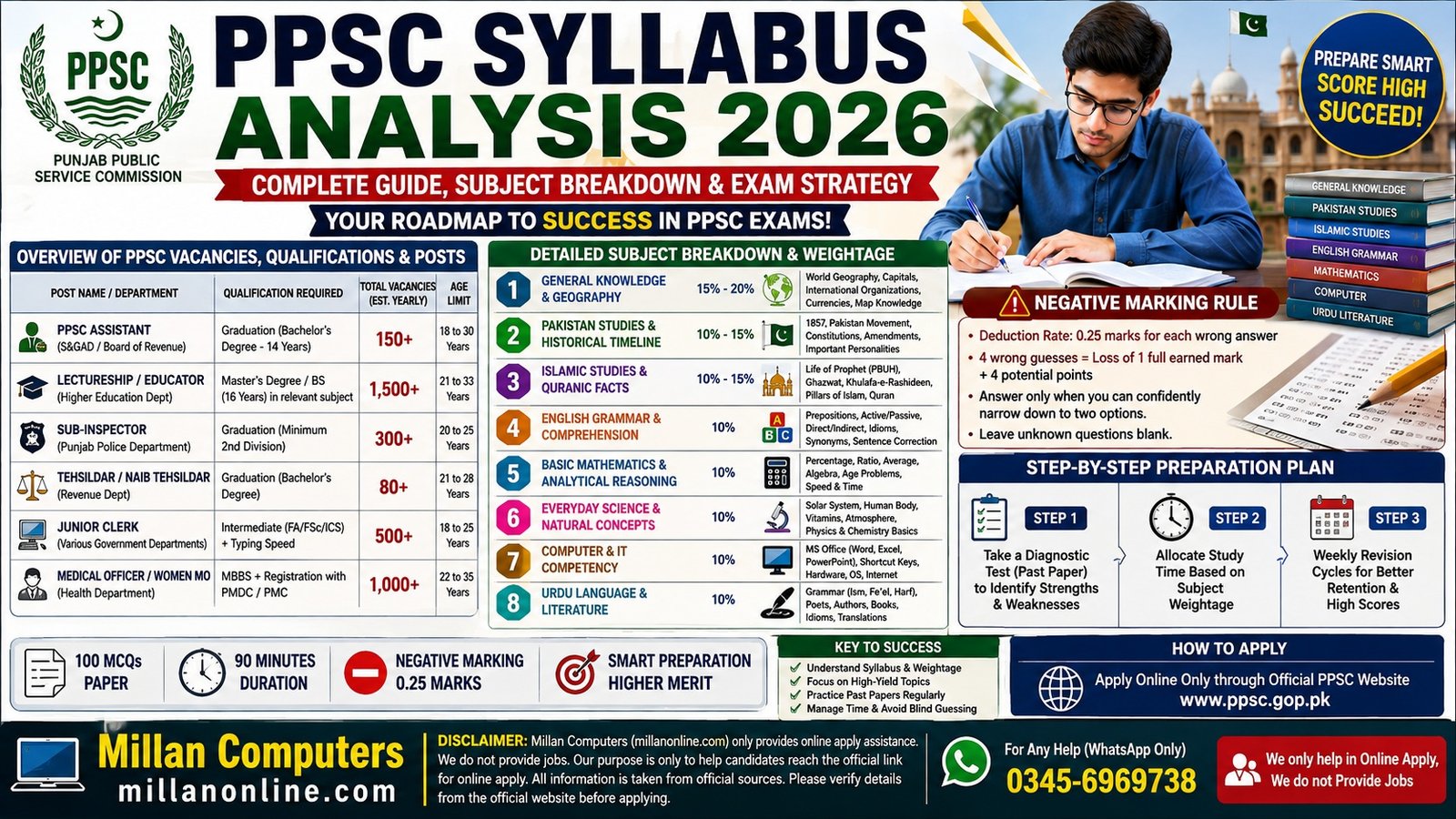
Mastering the PPSC Syllabus Analysis 2026 is the single most effective strategy for candidates aiming to secure competitive government jobs in Punjab. Every year, thousands of dedicated applicants attempt recruitment tests conducted by the Punjab Public Service Commission, yet only a small fraction successfully clear the merit line. The primary reason for this failure is not a lack of hard work, but a lack of structured preparation based on deep examination insights. Conducting a thorough analysis of the official curriculum allows aspirants to identify high-yield topics, allocate study hours efficiently, and eliminate wasted effort on irrelevant content. Whether you are preparing for administrative roles, lectureships, or law enforcement positions, this ultimate analysis provides the exact framework needed to maximize your written score.
Overview of PPSC Vacancies, Qualifications & Total Posts
Before creating a study schedule, applicants must review the general qualification criteria and post distribution announced across various departments.
| Post Name / Department | Qualification Required | Total Vacancies (Estimated Yearly) | Age Limit |
| PPSC Assistant (S&GAD / Board of Revenue) | Graduation (Bachelor’s Degree – 14 Years) | 150+ Vacancies | 18 to 30 Years |
| Lectureship / Educator (Higher Education Dept) | Master’s Degree / BS (16 Years) in relevant subject | 1,500+ Vacancies | 21 to 33 Years |
| Sub-Inspector (Punjab Police Department) | Graduation (Minimum 2nd Division) | 300+ Vacancies | 20 to 25 Years |
| Tehsildar / Naib Tehsildar (Revenue Dept) | Graduation (Bachelor’s Degree) | 80+ Vacancies | 21 to 28 Years |
| Junior Clerk (Various Government Departments) | Intermediate (FA/FSc/ICS) + Typing Speed | 500+ Vacancies | 18 to 25 Years |
| Medical Officer / Women MO (Health Department) | MBBS + Registration with PMDC / PMC | 1,000+ Vacancies | 22 to 35 Years |
Detailed Subject Breakdown in PPSC Syllabus Analysis 2026
A meticulous breakdown of individual subjects reveals where examiners focus their question banks. Below is the detailed weightage and critical topic mapping derived from historical exam trends.
1. General Knowledge & Geography (15% – 20%)
General Knowledge tests a candidate’s global awareness and analytical recall.
High-Yield Topics: World geography, physical features (deserts, rivers, mountain ranges), famous straits, international organizations (UN, OIC, SAARC, NATO), world capitals, and currencies.
Preparation Tip: Use map-based learning to retain geographical boundaries and strategic waterways quickly.
2. Pakistan Studies & Historical Timeline (10% – 15%)
This section covers pre-partition events, political developments, and constitutional history.
High-Yield Topics: War of Independence 1857, Sir Syed Ahmed Khan’s movements, 1906 Muslim League formation, 1940 Lahore Resolution, post-1947 constitutions (1956, 1962, 1973), and constitutional amendments.
Preparation Tip: Create a chronological timeline chart of major political events from 1857 to present day.
3. Islamic Studies & Quranic Facts (10% – 15%)
Islamic Studies focuses on foundational knowledge, historical battles, and Islamic jurisprudence.
High-Yield Topics: Life of Prophet Muhammad (PBUH), Ghazwat (Battles of Badr, Uhud, Khandaq), compilation of the Holy Quran, Rightly Guided Caliphs (Khulafa-e-Rashideen), and basic Pillar requirements (Zakat, Hajj, Fasting).
Preparation Tip: Maintain concise notes on dates, commander names, and significance of major Islamic events.
4. English Grammar & Comprehension (10%)
English tests core grammatical accuracy, vocabulary, and structural rules.
High-Yield Topics: Appropriate prepositions, active and passive voice, direct and indirect speech, idioms, synonyms, antonyms, and sentence correction.
Preparation Tip: Practice preposition rules daily and build a flashcard deck for recurring vocabulary words.
5. Basic Mathematics & Analytical Reasoning (10%)
Quantitative reasoning evaluates speed and numerical accuracy.
High-Yield Topics: Percentage calculations, ratio and proportion, average problems, age-related word problems, and basic algebraic simplification.
Preparation Tip: Learn mental math shortcuts to solve basic arithmetic questions in under 45 seconds.
6. Everyday Science & Natural Concepts (10%)
Everyday Science assesses fundamental scientific literacy across multiple disciplines.
High-Yield Topics: Solar system planets, human body physiology (blood composition, organs), vitamins and deficiencies, atmospheric layers, and basic physics/chemistry concepts.
Preparation Tip: Study Punjab Curriculum & Textbook Board (PCTB) Science textbooks for Grades 6 through 10.
7. Computer & IT Competency (10%)
Modern competitive exams heavily emphasize practical computing knowledge.
High-Yield Topics: Microsoft Office Suite (Word, Excel, PowerPoint), keyboard shortcut keys, hardware components, operating systems, and internet fundamentals.
Preparation Tip: Practice keyboard shortcuts directly on MS Office applications to build muscle memory.
8. Urdu Language & Literature (10%)
Urdu evaluates grammatical correctness and classical literary history.
High-Yield Topics: Famous poets and authors, titles of landmark literary books, Urdu grammar (Ism, Fe’el, Harf), idioms (Zarb-ul-Masal), and translations.
Preparation Tip: Review classical Urdu poets and memorize famous literary awards and publications.
Understanding Negative Marking in PPSC Syllabus Analysis 2026
Negative marking is a decisive factor that dictates success or failure in written tests.
Deduction Rate: 0.25 marks are deducted for every incorrect response.
Impact of Wild Guessing: Attempting 4 blind guesses incorrectly results in the loss of 1 full earned mark plus the 4 potential points.
Smart Strategy: Only answer questions where you can confidently narrow down the choices to two options. Leave completely unknown questions blank.
Step-by-Step Execution Plan for Candidates
Step 1: Conduct a Personal Diagnostic Test
Solve one recent past paper without referring to study material to determine your natural strengths and weaknesses across all subjects.
Step 2: Allocate Study Time Based on Weightage
Divide your daily study routine (4 to 6 hours) proportionally. Spend more time on heavy-weightage subjects like General Knowledge, English, and Pakistan Studies.
Step 3: Implement Weekly Revision Cycles
Consistently revise previously studied material every weekend. Retention is heavily dependent on spaced repetition.
Frequently Asked Questions (FAQs)
Q1: How does a deep PPSC Syllabus Analysis 2026 improve my final score?
Analyzing the syllabus helps you prioritize high-yield topics, avoid wasting time on rare questions, and build a targeted preparation routine tailored to examiner preferences.
Q2: Is the syllabus same for all One-Paper MCQs examinations?
While the primary subjects (GK, Pak Studies, Islamiyat, English, Math, IT) remain consistent, the internal subject weightage can fluctuate depending on the specific job description.
Conclusion
Leveraging this comprehensive PPSC Syllabus Analysis 2026 transforms a chaotic preparation journey into a structured, result-driven path. By understanding subject weightages, mastering high-yield topics, and managing negative marking smartly, you significantly elevate your standing on the competitive merit list. Start organizing your study plan today and take a decisive step toward securing your dream government position in Punjab!